
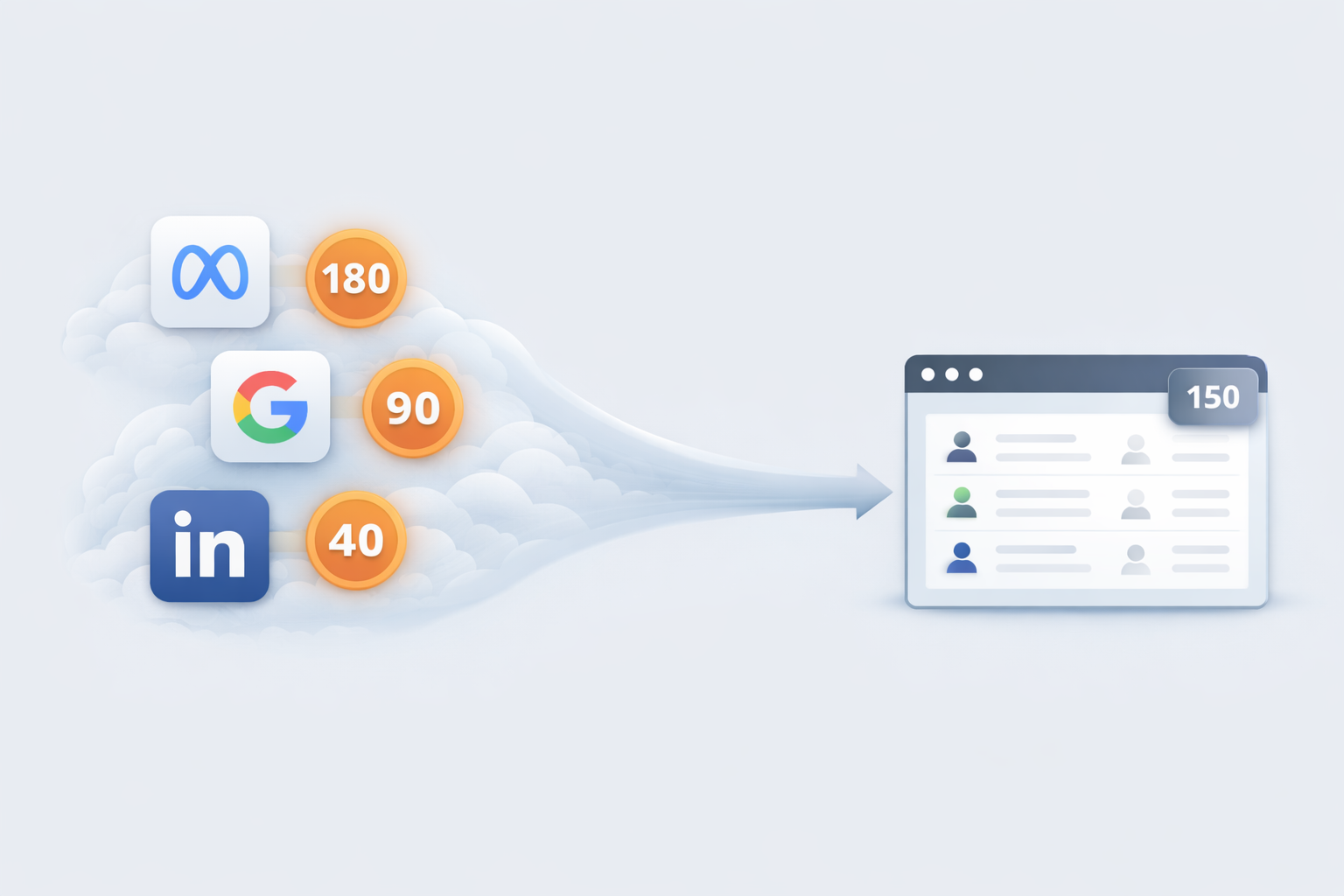
Ever tried adding up conversions across all your ad platforms?
Meta reports 180.
Google reports 90.
LinkedIn reports 40.
Total: 310 conversions.
You open the CRM - there are 150 actual leads.
Marketing math can feel absurd sometimes.
But this is not a bug. It is how attribution works inside walled gardens.
Every Platform Lives in Its Own Reality
Each ad platform operates inside its own attribution model.
Its own:
- Lookback windows
- Click logic
- View-through rules
- Cross-device assumptions
- Conversion definitions
Google says it generated the lead.
Meta says it did.
LinkedIn might agree too.
Meanwhile, your CRM quietly holds the only version of the truth:
There is one person.
One submission.
One lead.
How Double Counting Happens
Let’s walk through a realistic journey:
- Monday - User clicks a Google Search ad
- Wednesday - User sees and clicks a Meta retargeting ad
- Friday - User converts after returning via email
Who gets the credit?
Under most platform models: everyone.
Each system sees a touchpoint inside its attribution window and claims the win.
Now multiply that behavior across hundreds or thousands of users.
If you evaluate performance using platform-reported conversions, you are almost certainly double-counting.
Often aggressively.
And Then There’s View-Through Attribution
This is where things get even more entertaining.
A user scrolls past your ad.
Does not click.
Barely registers it.
Four days later, they convert through another channel.
The platform says: “They saw your ad. That counts.”
View-through attribution has its place, but when misunderstood, it inflates perceived performance and distorts budget decisions.
If you are not careful, you end up rewarding impressions instead of influence.
The Only Way to Get Closer to the Truth
You cannot solve this problem inside the ad platforms themselves.
The only reliable approach is this:
- Pull spend data from each platform
- Merge it with CRM data
- Evaluate performance based on real leads and real pipeline outcomes
- Judge channels by revenue contribution - not self-reported conversions
Your CRM does not care about attribution windows.
It cares about actual people.
Actual deals.
Actual revenue.
Attribution Is Messy - By Definition
Discrepancies are not a sign something is broken.
They are mandatory in a multi-touch environment.
The mistake is pretending that one platform’s dashboard represents objective truth.
Smart marketers understand:
- Platform numbers are directional
- CRM data is grounding
- Strategy must be built on unified reality
If you optimize based on fantasy conversions, your budget decisions will eventually drift away from business results.
If you optimize based on real, reconciled outcomes, your strategy becomes resilient.
Attribution will never be perfectly clean.
But your thinking can be.