
Let’s say this clearly:
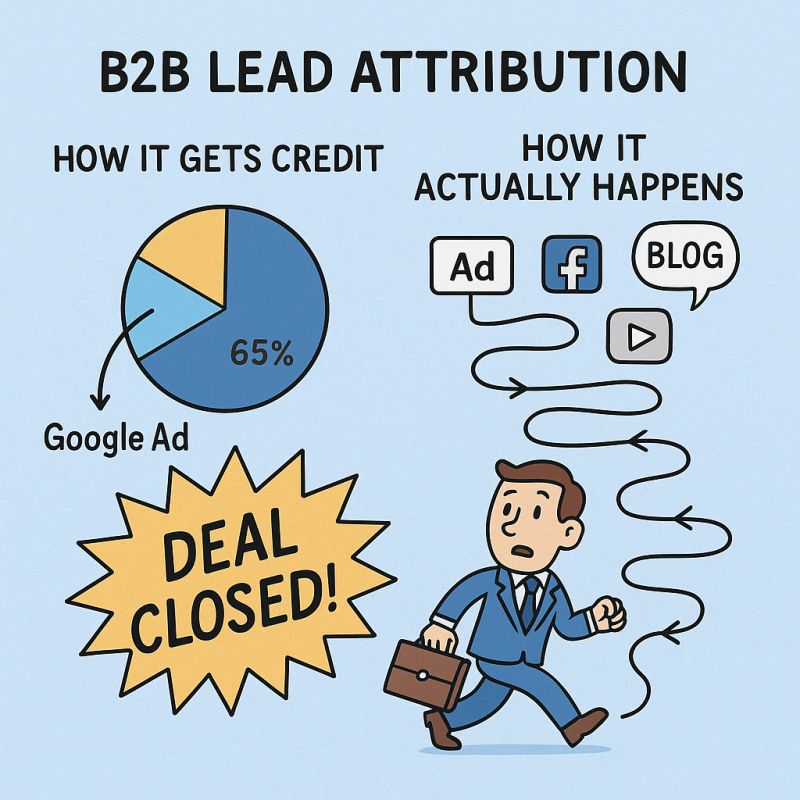
Attributing a B2B lead - especially one that turned into a serious deal - to a single campaign is not just inaccurate.
It is fundamentally disconnected from how buying decisions actually happen.
Yet one of the most common obsessions in B2B marketing is the hunt for the “magic dashboard” - the one that will finally reveal which campaign generated that high-quality lead that closed the biggest deal.
The perfect answer.
The winning channel.
The one keyword that “did it.”
Let’s get real.
Trying to compress complex human decision-making into a neat 2D spreadsheet cell is, at best, a misunderstanding of reality. At worst, it is laziness disguised as data-driven thinking.
You’re Not Running a Lemonade Stand
You are a tech company.
You have:
- Investor money
- A complex product
- A multi-touch media mix
- A long sales cycle that can take months - even in a best-case scenario
- Multiple stakeholders involved in every decision
Start acting like it.
Saying you closed a six-figure deal “because of a Google keyword” or “thanks to a Facebook ad” is like saying you lost 20 pounds because of your fifth gym session.
It ignores everything that came before it.
And everything that made that moment possible.
B2B Buying in 2026 Is Multi-Touch by Nature
Deals close because of dozens of touchpoints:
- Paid ads
- Organic posts
- Referrals
- Remarketing
- Blog content
- Webinars
- Case studies
- Video snippets
- Sales conversations
- Conference interactions
- Even that branded hat you handed out at an event
Each touchpoint did not “close the deal.”
Together, they built trust.
And trust is what closes deals.
The Question I Still Get Every Week
“Which campaign did this lead come from?”
Internally, my answer is always the same:
The same way you chose your career.
Or married your partner.
Not because of one moment.
But because of a journey.
Buyers do not wake up, click an ad, and sign a contract.
They:
- See you
- Forget you
- Hear about you again
- Google you
- Click
- Leave
- Get remarketed
- Get slightly annoyed
- Hear you mentioned on a podcast
- Revisit
- Talk to a colleague
- Reconsider
And eventually - maybe - book a meeting.
And even then, that meeting only turns into a deal if you convince the rest of the decision-makers inside their organization.
Meanwhile, marketing teams are trying to give all the credit to the “last click,” while the buyer just went through an emotional, cognitive, political, and budgetary rollercoaster.
And none of that shows up in your traffic acquisition report.
Your Ad Didn’t Close the Deal
The trust you built did.
The consistency of your message did.
The repetition did.
The content did.
The proof did.
The brand did.
Stop searching for a single winner.
Start understanding the system.
Attribution Should Reflect Reality, Not Simplify It
This is not about “Google vs. Facebook vs. LinkedIn.”
It is about how those channels interact.
How they reinforce each other.
How they reduce perceived risk.
How they move the buyer forward - faster, safer, and more confidently.
Attribution in B2B should help you understand momentum, influence, and contribution.
Not crown a single hero.
Because in complex sales cycles, there is no hero channel.
There is only orchestration.
And the teams that understand orchestration - not last-click glory - are the ones that win consistently.