
If you are running digital ads in 2026 without first-party tracking infrastructure, you are not just missing out on performance gains.
You are actively hurting your results.
That may sound dramatic - but it is simply the current reality of the ecosystem.
Browsers are tightening privacy controls.
Ad blockers are getting smarter.
iOS restrictions are not going anywhere.
Third-party cookies are fading out.
And yet, many advertisers are still relying solely on traditional client-side pixels - the same approach that worked a decade ago.
That approach is now fragile.
And fragile tracking leads to fragile performance.
What Do We Mean by First-Party Tracking?
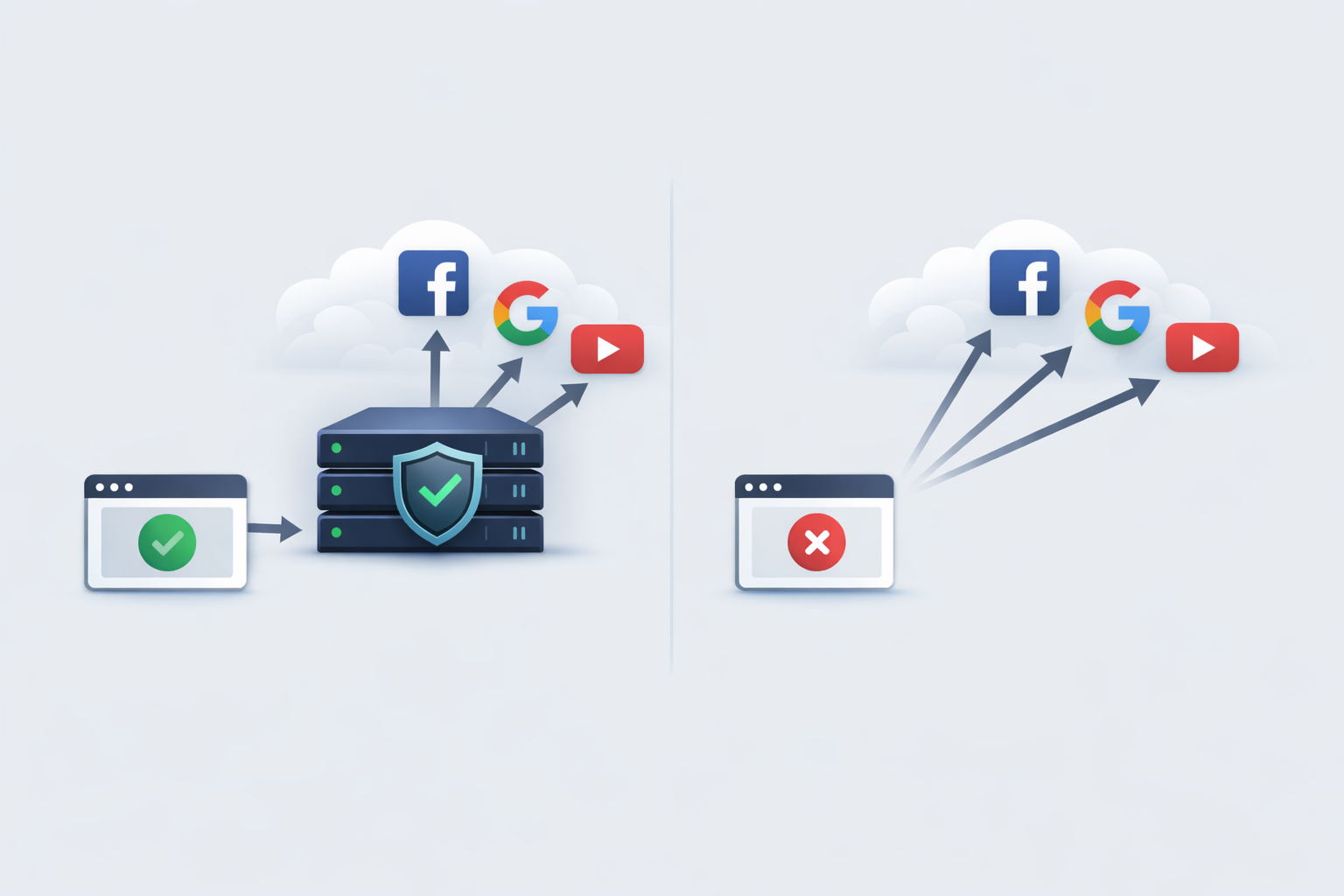
When we talk about first-party tracking, we mean server-side tracking hosted on your own domain.
Instead of the browser sending data directly to platforms like facebook.com or google.com, events are first sent to your server endpoint and then forwarded to the relevant ad platforms.
That architectural shift changes everything.
If you are spending more than $100 per month on ads, this is no longer an advanced tactic.
It is baseline infrastructure.
Why First-Party Server-Side Tracking Matters
🍪 Longer Attribution Windows
First-party cookies stored on your own domain last longer than third-party cookies.
That means:
- Better attribution accuracy
- More complete conversion paths
- Stronger remarketing audiences
- Fewer “lost” conversions
When your attribution window shrinks unintentionally, your algorithms learn from incomplete data.
And incomplete data leads to weaker optimization.
⛔ Ad Blocker Resistance
Modern ad blockers often block browser requests sent directly to known ad platform domains.
But when events are routed through your own server first, they are far less likely to be intercepted.
That translates into:
- More reliable event delivery
- Fewer tracking gaps
- More stable performance signals
You cannot optimize campaigns based on data that never arrives.
📊 Smarter Data Control
Server-side tracking gives you control before data leaves your environment.
You can:
- Filter out bot traffic
- Apply consent logic properly
- Enrich events with geolocation or backend data
- Remove noise before it reaches ad platforms
Instead of sending raw browser events, you send cleaner, more structured, higher-quality signals.
Ad platforms optimize better when the signals are stronger.
💪 Built-In Durability
Client-side pixels depend on:
- Browser behavior
- Script loading order
- User privacy settings
- Frontend stability
Server-side tracking reduces that dependency.
It acts as a buffer against:
- iOS tracking limitations
- Third-party cookie loss
- JavaScript errors
- Page speed conflicts
It is not just about improving performance.
It is about protecting it.
This Is the New Baseline
The performance marketing landscape has fundamentally changed.
First-party and server-side tracking are not “advanced growth hacks.”
They are the new minimum standard for serious advertisers.
If your current setup still looks like it did in 2016, 2026 should be the year you upgrade your infrastructure.
Because in modern paid media, the advertisers with the strongest data pipelines are the ones who win.
Not because they have better ads.
But because their systems feed the algorithms better signals.